
Current Challenges within Constructionin the EUin the USin the WORLD

HOUSING SHORTAGE
Worldwide about 1.6 Bio. People don't have a secure long-term roof above their head (Architecture & Design, UN Habitat). Following this definition approximately 18.5 % of the world's population is homeless. We protect human rights all across the globe but one of the most essential "the right of adequate housing" is globally not being fulfilled. We protect human rights all across the globe but one of the most essential "the right of adequate housing" is globally not being fulfilled.
TIME INEFFICIENCY
An low-end one-family house takes about 1500 hours to build by conventional construction. Given the fact that approximately 2.3 Bio. Houses exist around the world, we would require about 425 Mio. new homes to solve homelessness today. Adding up we need approx 637.5 Bio. working hours. Construction employs about 7 % of the employable world population, which gives us about 257,6 Mio. Workers to split these working hours. With a 8 hour day and an average of 250 work days per year it would take all construction workers around the world 1.23 years to build these houses.


RISING WORLD POPULATION
Keep in mind that we have calculated for a static number. The problem is, that the number of necessary houses rises every year, with the increase of population. Today we have about 8.2 Bio. People on earth. Until 2100 this number will increase to around 11.2 Bio. (+36%), and thus will the number of houses required for these people.
LABOUR SHORTAGE
We would love to know and tell you a number on how many skilled workers are lacking in the construction sector. Unfortunately this number can't be found. It's a fact that construction is lacking workforce, but the question is if there is a benefit to more workers in this sector?
Even for small-scale projects costumers have to wait months for an available expert.


PARTIES INVOLVED
Every Party involved in a construction process needs to gain money. But even if the margins would be kept low a business must add costs to the costumer to lower the risk if repairs or corrections get necessary. Since there are so many parties involved in building a house, a lot can go wrong.
INEFFICIENCY IN CONSTRUCTION
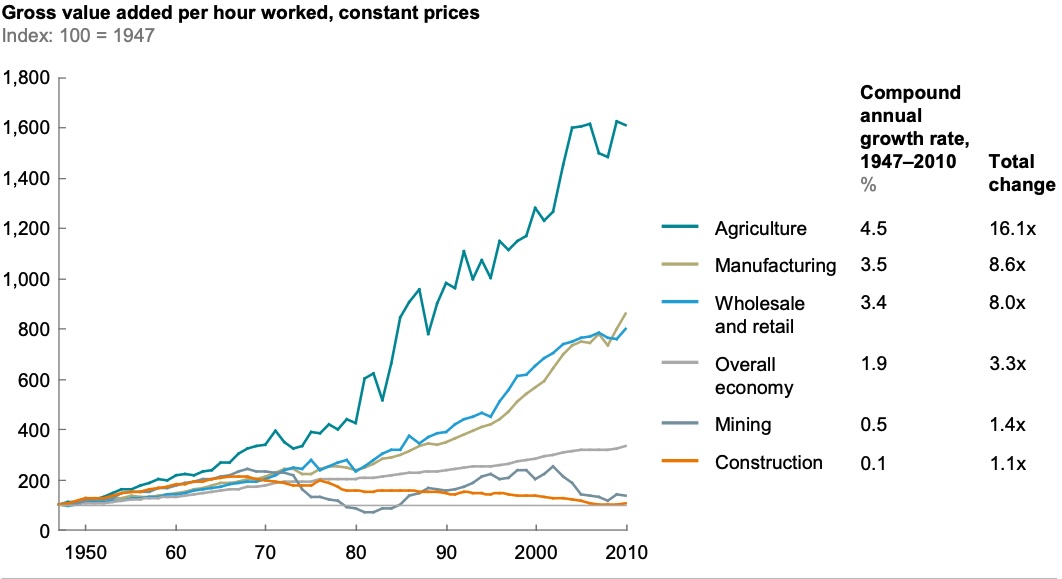
Unfortunately the construction sector is the only sector in the world where an additional worker costs more than there is benefit! Through this, the construction sector is the only sector with a negative productivity increase per year today. Where the global productivity averages with an increase of about 2.8 % per year, the productivity of the construction sector increased by 1 % over the past 20 years. Currently being negative (McKinsey 2017).
WASTE MANAGEMENT
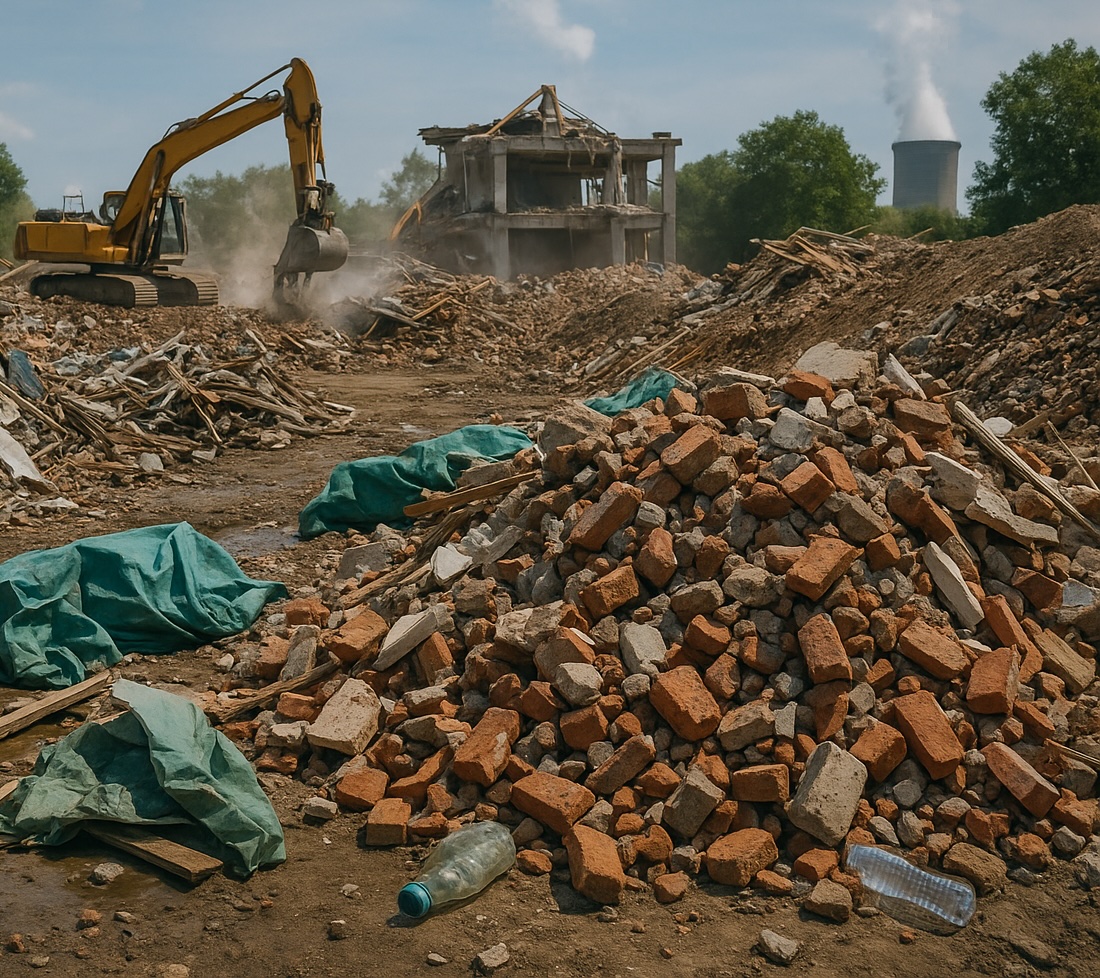
The construction sector worldwide is responsible for more than 40 % of solid waste and 38 % of greenhouse gas emissions. The sector requires 12 % of global drinking water.
Construction Materials like sand are limited and yet we are wasting tons of materials day in day out. Mostly not being able to reuse them as primary building materials.
Why is Additive Manufacturing in Construction not solving the problem?
INITIAL INVESTMENT COST
With entire printing systems ranging from 100k to >1 Mio. € the initial investments for companies are tremendous.
Companies must fully commit to AMC without knowing the effects of their investment. The crucial question remains: When is the Return of Investment (RoI)?
LABOUR SHORTAGE
We are lacking construction workers and automation can solve this as successfully demonstrated by many industries around the world.
But what we are facing in AMC is that we are literally shifting the labour shortage, since no experts are being educated. Operating a business with AMC technology requires an interdisciplinary team with designers, automation- and systems engineers, as well as material scientists. The other option is very expensive workers with interdisziplinary knowledge.
So next to a comitment on tech investments an enormous investment in HR is also to be carried.
LACK OF AUTOMATION
Unfortunately most of the people confronted by AMC think: "We push a button and the system prints what we want". We are sorry to disappoint you, but this is not the case.
Marketing campaigns around the world make it look easy, but since concrete is a natural material it can vary enormously. Its a fact that the same material from a 25kg package taken from the bottom of the pallet its stored on can behave completely different from the one on top. At the moment there are no fully autonomous machines that don't require human input that compensates changes in Environment and Material.
The main reason for this is that there is no way to evaluate material properties during the process in order to make changes to the process parameters based on material data.
MATERIAL
The materials used for 3D concrete printing must be designed for the system it is used in. The different systems require different material consistencies if the process is to be optimized.
Across the globe multiple material companies have developed universal materials that are usable in a commercially available printing systems, yet the process can never be optimized, since the material recipes are protected. Also the high amount of money invested into these materials must be compensated for. Today the user pays between 2,5-5 times more for a 3DCP DryMix than for conventional construction concrete. With generally low margins the high material costs make an optimized in-house material development inevitable for competitive prices of 3D printed objects on the market.Furthermore the sustainability of AMC is massively reduced by not having licensed production of such materials in all countries. Resulting logistics of fairly heavy material across borders has a negative effect on CO2 Emissions through transport but increasing cost by factor 3.
LACK OF STANDARDS
We have been building houses in the way we are building them today for around 100 years. Nothing fundamentally changed to "back in the days".
These standards heavily rely on experience, that guarantee a reliable structure with little effort of individual calculation. Bottom line the standard say "If you use concrete X and do Y the structure will last for at least 50 years".
Now since 3D printing is a new technology with mentionable advancement over only 20 years, this industry is lacking experience that can be used for standards.
Today there is a handful of standards stating the most basic naming conventions, but these are far from giving the user reliable information on the process and material itself.
Researchers around the world are working on establishing new standards. Yet the benefits of process monitoring and flexibility of an automated process are not exploited. Instead of giving the manufacturer the possibility of taking responsibility for structures, extensive testing is mandatory to document properties that are clearly fulfilled in order to build a structure like houses.
AUTOMATED PROCESS IN MANUAL FRAMEWORK
An efficient process in an inefficient manual Framework still results in an inefficient Process as a whole. Adding automation to construction is definetively a way to up productivity, but therefor the entire process must be rethought disruptively and not only parts of it. If not adopted to current technology standards, the process of building houses with the many parties involved is and allways will be inefficient in itself. There is an urgent need for parallelizing AND digitalizing processes.
RESEARCH EFFORTS
As mentioned, 3D printing is a highly intrecate process that is very reliant on a reproducable process. Some influencing parameters are: Enviromental temperature, environmental humidity, material temperature, material humidity, dosing accuracy, mixing time, mixing intensity, pumping distance, hose radius, etc.
As a matter of fact there are so many influencing factors that one can not keep them all constant to generate reliable results without deviations of 30 %. But even if these factors could be kept constant, the results maintained are only valid for the specific system and material they have been generated with. Why? Because there are not enough empirical date related to one reference system, nor the mathematical equations to correlate data especially if they are not based on isolated variations. Not even AI can help us without empirical data its decisions are based on.
Bottom line is we are wasting millions in funding to generate data that will be forgotten in the archives of universities. Even if this data is published its not usable but for the transfer to another printing system. Only the relative evaluation is possible today.


